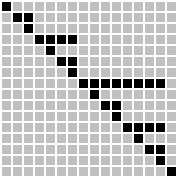
| Code fragment | Cells visited on an n x n array (outer/inner loops correspond to columns/rows respectively) | Time complexity |
|---|---|---|
for ( i = 1; i <= n; ++i )
   for ( j = 1; j <= n; ++j )
      printf(...);
| 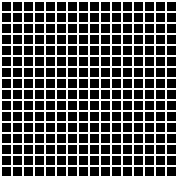
| Theta(n^2) |
for ( i = 1; i <= n; ++i )
   if ( i <= m ) {
      for ( j = 1; j <= n; ++j )
         printf(...);
   }
| 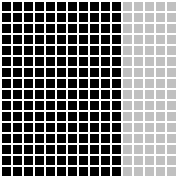
| Theta(n*min{n,m})
This is one example of how complexity can be a function of more than just one variable. |
b = n;
for ( i = 1; i <= n; ++i ) {
   for ( j = 1; j <= n; ++j )
      --n;
   n = b;
}
| 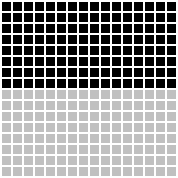
| Theta(n*(n/2)) = Theta(n^2) |
for ( i = 1; i <= n; ++i )
   for ( j = 1; j <= i; ++j )
      printf(...);
| 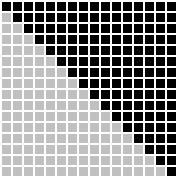
| Theta(1+2+3+...+n) = Theta(n*(n+1)/2) = Theta(n^2) |
b = n;
for ( i = 1; i <= b; ++i )
   for ( j = 1; j <= n; ++j )
      --n;
| 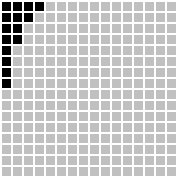
Here we have the area under an exponential curve! | Theta(n/2+n/4+n/8+n/16+...) = Theta(n) |
for ( i = 1; i <= n; ++i )
   for ( j = 1; j <= n; ++j )
      --n;
| 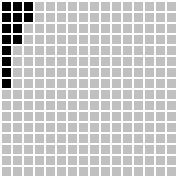
Unlike the previous example, here the exponential curve is cut off early. | Theta(n/2+n/4+n/8+n/16+...) = O(n)
Can a better bound be found ? I suspect the tightest bound you can get is something like O((1-0.5^k)*n), where k is such that n=k*2^k. |
for ( i = 1; i <= n; i <<= 1 )
   for ( j = 1; j <= n; ++j )
      printf(...);
Note that "i <<= 1" is just another way of writing "i *= 2". Which way of writing it is more efficient? And which way should we write it, assuming we have a good optimizing compiler? | 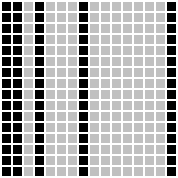
| Theta(n*log(n)) |
for ( i = 1; i <= n; i *= 2 )
   for ( j = 1; j <= i; ++j )
      printf(...);
| 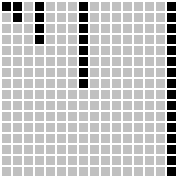
| Theta(1+2+4+8+...+n) = Theta(2*n-1) = Theta(n) |
for ( i = 1; i <= n; ++i )
   for ( j = i; j > 0; j &= j - 1 )
      printf(...);
What is the effect of "j &= j-1" ?
This produces a self-similar, fractal pattern!
|