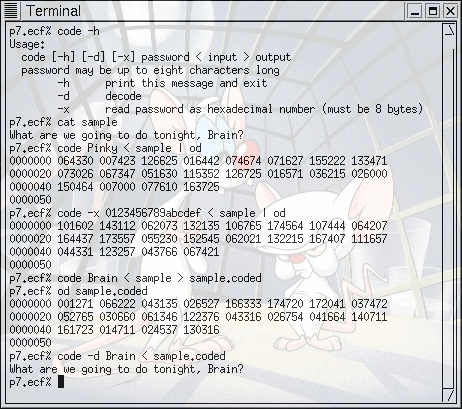
[ polloc ] This is a simple stream cipher encryption program. The screenshot shows the help available from the program and a file being encrypted with several different keys and then decrypted.
[ sapiano ]
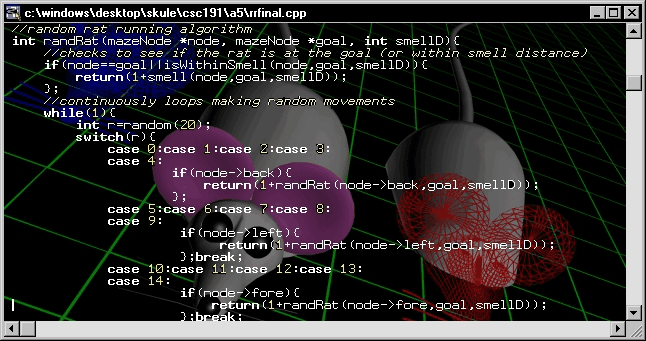
Project Description: Two computerised rats run a maze in a test of overall efficiency of a brute force algorithm vs. a dumb luck algorithm. The total number of moves required by each rat to run 1000 mazes can then be compared under various conditions (maximum maze depth, the ability of the rats to smell the goal a few nodes ahead).
Image Description: A snippit of some delightfully obfuscated code making use of the switch statement fall through. The screen shot has been doctored with a gratuitous semi-transparent image of some computerised rats in the background.
[ spokoin ]
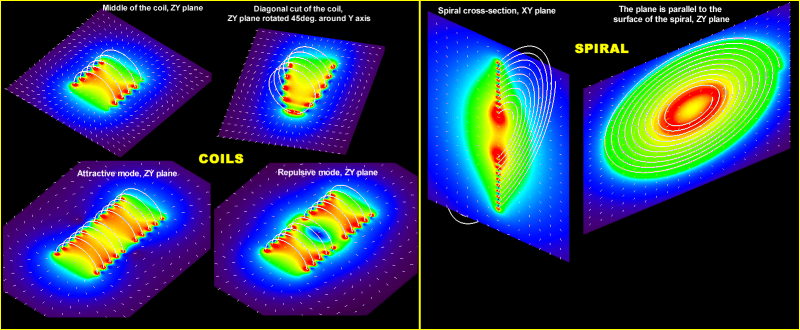
Project Description: The purpose of this project is to simulate static magnetic field in 3D. The program uses OpenGL and GLUT for drawing and 3D transformations. The field is calculated by dividing the wire into many pieces and using Biot-Savart's law to calculate field at particular point on the cutting plane. The strength of the field is represented by the color: black - no field, red - maximum intensity field. User can rotate/translate the viewpoint and the objects using the keyboard.
Image Description: The image consists of several runs with very high number of segments per object (approx 9000 polygons per plane and 2000 line seg.'s per inductor; it took approx 1 h for all of them). As you can see on the left image the field in the coil is concentrated closer to the walls rather than in the middle (I first thought otherwise). Bottom middle images confirm common sense that in repulsion mode the field between the coils is nill and in attractive mode is additive. For better resolution go to http://coolboris.150m.com
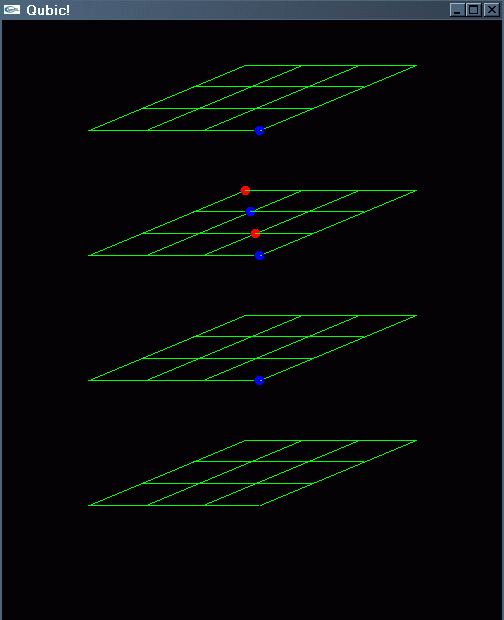
[ suwanda ] 3D Tic Tac Toe (Qubic) was implemented using GLUT and developed on Microsoft Visual C++ 6.0.

[ tancau ] A set of C++ classes that encapsulate a neural network were implemented. A text-based user interface was created to allow the user to create, train, test and use neural networks of any complexity for any kind of task imaginable. Additionally, a set of utilities that convert neural net data to/from PPM images were written and with their help a neural network was made to recognize hand-written digits. The project also involved a detailed analysis of the effect of training parameters on the training time and success rate for simple neural nets (not shown here). For a neural net primer, visit http://psy.uq.oz.au/~brainwav/Manual/BackProp.html.
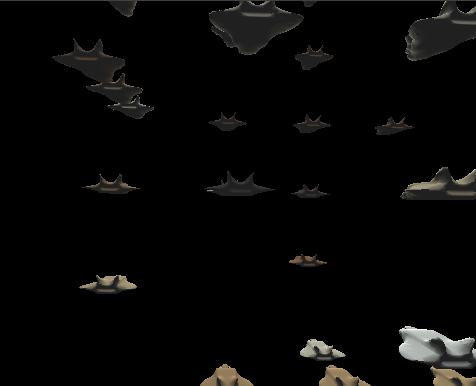
[ teper ] The view from inside a living area in an optimized version of a 3 dimensional version of conway's the game of life. Each ship represents a living cell in the space.
[ weig ]
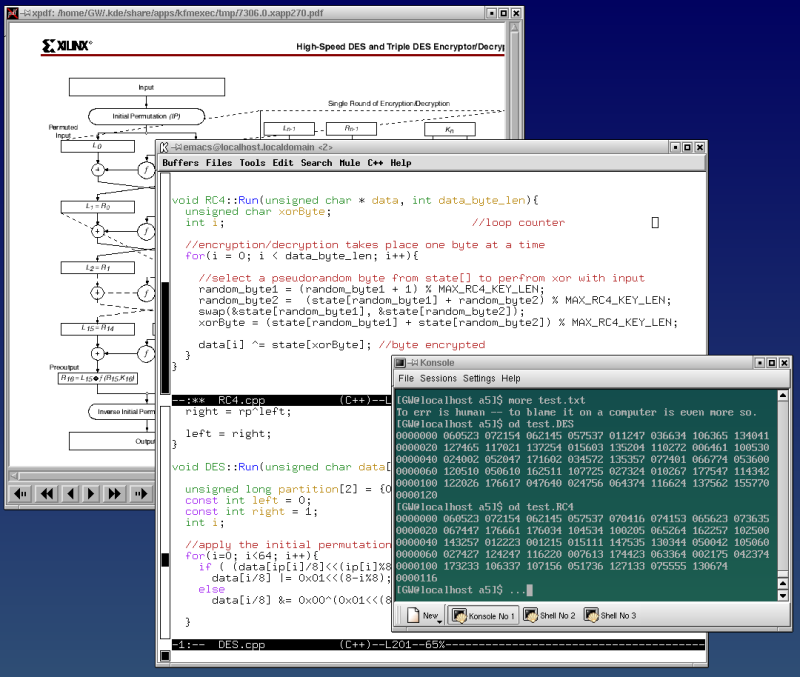
Project Comment: Encryption using DES (block cipher), RC4 (stream cipher), and MSA (block cipher, stands for My Simple Algorithm).
Picture Comment: The shell window displays the encryption results with the DES and RC4, while the emacs windows shows segments of the code for the two algorithms. In the background, the xpdf window contains a nice diagram illustrating the procedures involved in carrying out DES.
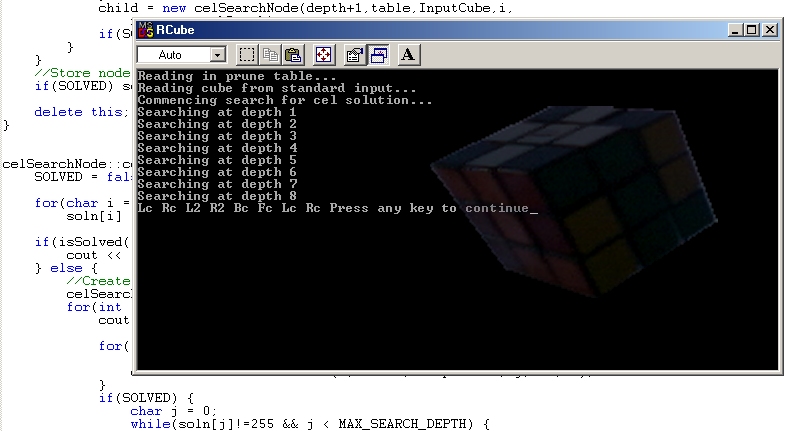
[ wond ] The "cel Solver" program is capable of generating a pruning table, reading in a Rubik's cube's state, and generating a series of maneuvers that puts the cube into a state such that the maneuvers required to solve it are limited to only {L2, R2, B2, F2, U, D}, thereby reducing the 4.32 x 10^19 possible states to 8! * 8! * 4! = 3.9 x 10^10.
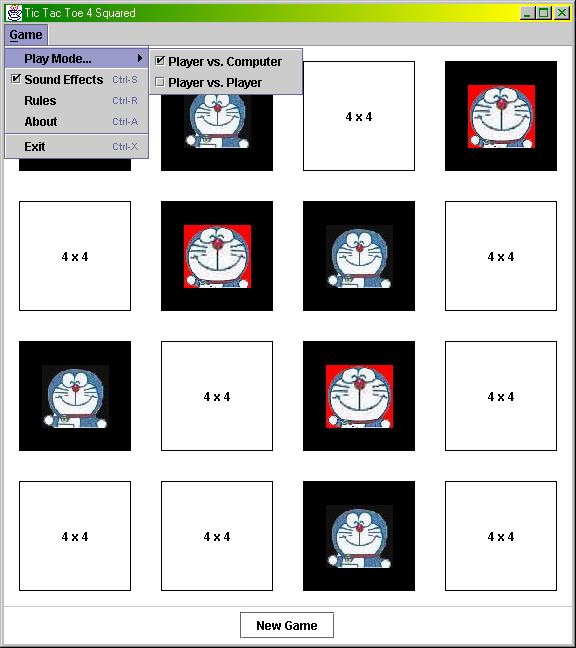
[ wuv ] The game of tic tac toe on a 4 x 4 board was implemented. The game has a player vs. player mode as well as a player vs. computer mode.
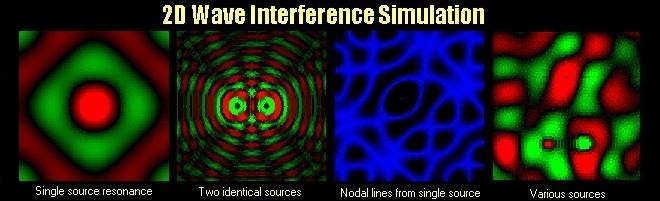
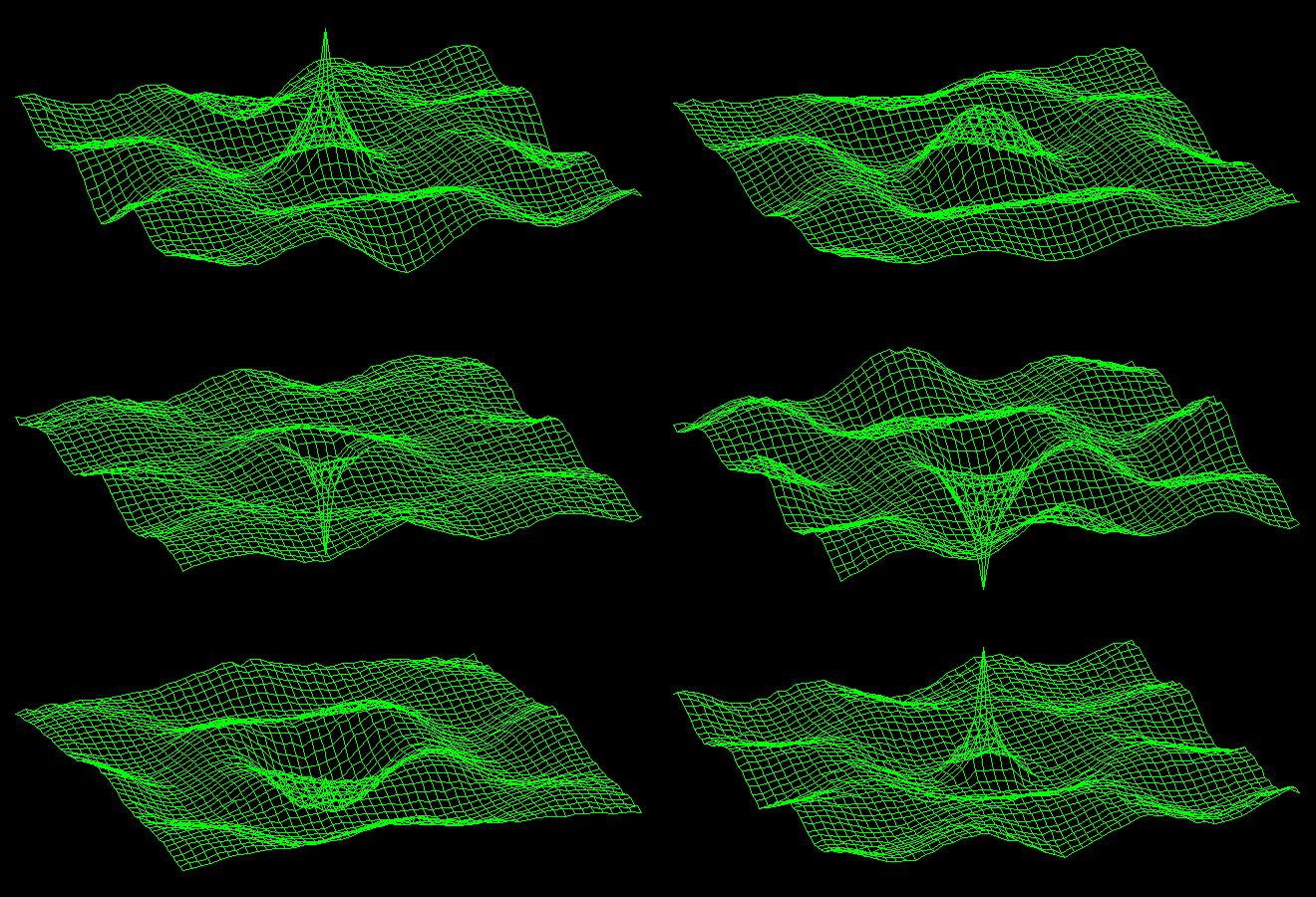
[ ziman ] A java applet was written that simulates the interference of surface waves in a two-dimensional medium. The simulation is animated, has variable resolution, and is flexible enough to model multiple point sources of arbitrary characteristics in a rectangular sheet. Wave reflection off of fixed or free edges, variable frequency speed, and energy density were also taken into account.