Inter-Photon-Limited Videography


1University of Toronto 2Vector Institute 3Purdue University

CVPR 2026, Highlight

We consider the problem of imaging a dynamic scene when scene appearance variations can outpace photon arrivals. Under such conditions, a pixel is effectively "blind" to changes in appearance that occur within the timespan separating the photons it detects, and so the inter-photon interval presents a significant speed barrier to video acquisition systems. To analyze and advance imaging capabilities at the inter-photon limit, we introduce a novel reparameterization of time-varying flux that reveals the intrinsic difficulty of signal reconstruction by relating the Fourier decomposition of a flux function to the number of photons arriving within each oscillation period. We find that inter-photon-limited videography of general scenes is underexplored and beyond the reach of existing reconstruction techniques. To this end, we introduce Neural Flux Fields (NFFs)—a technique that combines statistical modeling of photon arrivals with intrinsic priors of a neural network to achieve robust videography at the inter-photon limit. Using this approach, we demonstrate never-before-seen capabilities in video reconstruction across a range of captured single-photon video datasets spanning the inter-photon-limited regime.

Inter-Photon-Limited Conditions

As the overall light level in a scene decreases, photons arrive farther apart on average and become individually resolvable. As the light level decreases even further, pixels become “blind” to variations that unfold over progressively longer timespans. We analyse and show robust videography in this inter-photon-limited condition, where scene variations may outpace photon arrivals

Inter-Photon Flux

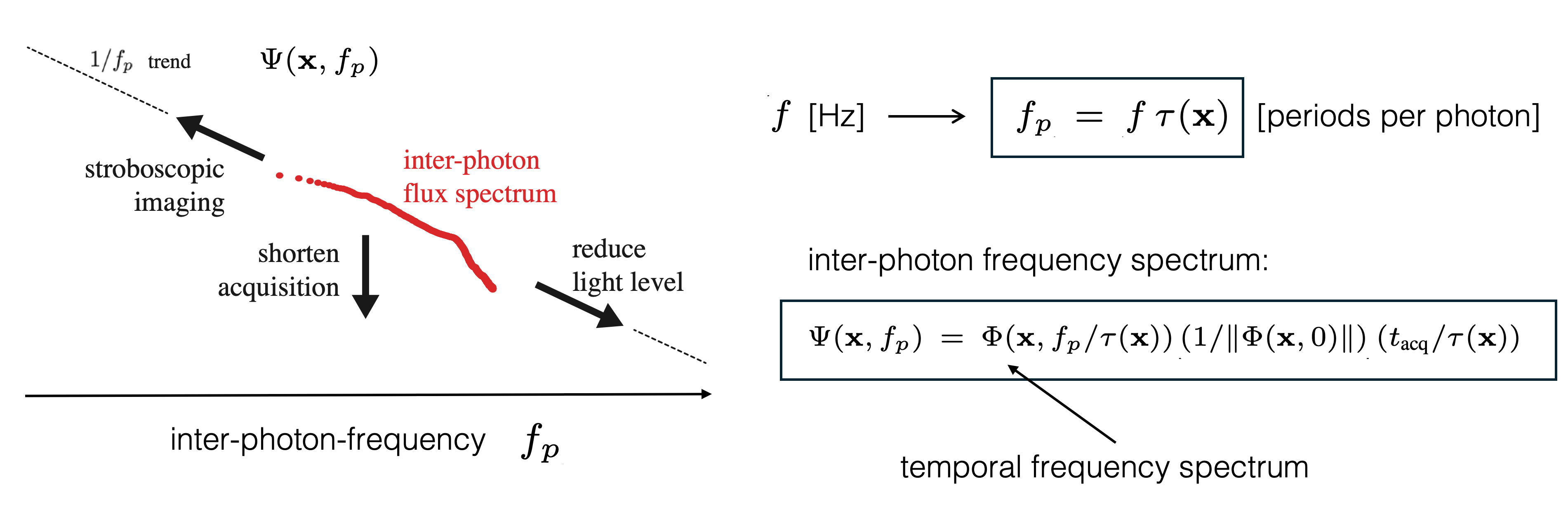
Inter-photon flux parameterization redefines a scene's time-varying flux in units of periods per photon. The inter-photon flux is independent of any absolute timescale or illumination level and shows the equivalence of the signals that would have parameter estimates with identical statistical uncertainty.

Inter-Photon Spectra
Inter-photon sprectra figure

The inter-photon spectra, the Fourier decomposition of the inter-photon flux, also has several ramifications within and beyond single-photon camera modeling. Firstly, it exposes imaging constraints not captured by conventional flux representations.
Inter-photon regimes figure

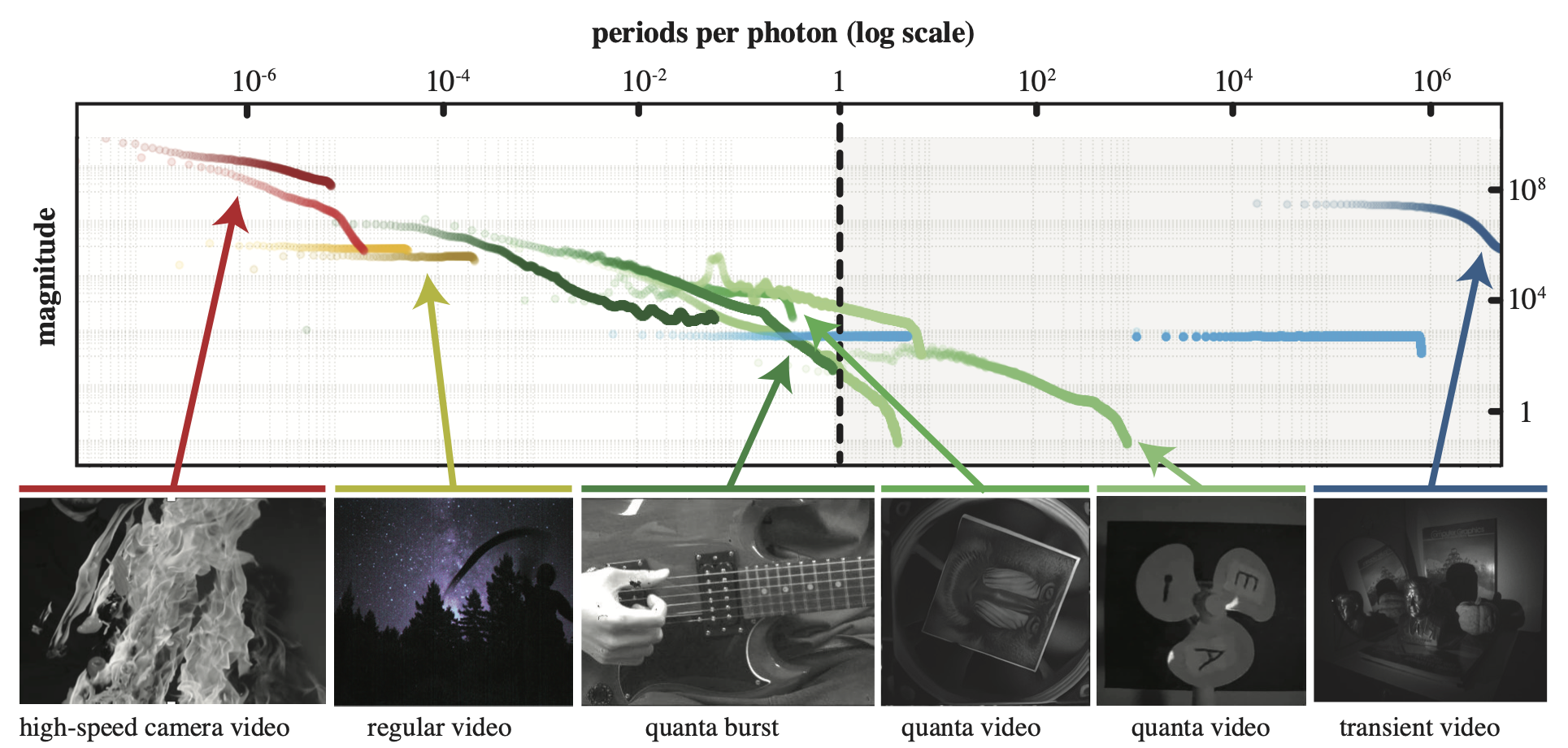
The inter-photon spectra also provides a timescale-invariant basis for performance assessment—replacing absolute metrics such as illuminance (lux) or frame rate with an inter-photon frequency response and reveals a unified imaging landscape spanning more than fourteen orders of magnitude in inter-photon frequency, encompassing both passive and active imaging systems. We find that the centroid \((f_p)\) of the inter-photon spectra provides a good estimate of intrinstic signal reconstruction difficulty.

Neural Flux Fields

Neural Flux Fields figure

We address the problem of inter-photon-limited videography by training a Neural Flux Field (NFF)—a neural network that estimates time integrals of the flux function from photon detection data across a sensor. NFFs \(\Phi_\theta\) takes a temporal coordinate as input, passes it through a temporal frequency encoding function \(\gamma\). This encoding is processed by a multi-layer perceptron, whose output is shaped into a spatial tensor and processed by convolutional layers. Finally, the resulting predicted video frame \(\hat{v}(\mathbf{x})\) is compared to the measurement frame \(\tilde{v}(\mathbf{x})\), and we optimize \(\Phi_\theta\) to maximize the likelihood of the photon measurements.

Video Results

Recovering Videos Across a Range of Inter-Photon Frequencies

Below, an elevator scene is played back at 225fps (top) and 98.4kfps (bottom) along with the original corresponding binary frames captured by the SPAD512 single-photon camera. We show two playback speeds to illustrate the range of inter-photon frequencies captured: from the fast flickering elevator lights to the large motion of the jumping person to the slow moving elevator doors. Each frame has an exposure of 10us. We then simulated more difficult conditions with binomial thinning up to a factor of 1024.

We show video reconstructions and comparison between NFFs and other SOTA unsupervised single photon video reconstruction methods in the context of the inter-photon spectra.


We compare against Quanta Burst Photography (QBP) using a scene from QBP's dataset at two different inter-photon frequencies. At high inter-photon frequencies, there are inadequate photons to accumulate and QBP reconstruction resembles the binary input.


We compare against bit2bit using a scene from bit2bit's dataset. bit2bit returns blurred images at higher inter-photon frequencies while our reconstruction is unaffected.


A single pixel method such as flux probing (UWB) fails to reconstruct a fan spinning even though it is well suited for periodic phenomena, since it neglects spatial correlations and the SNR at each pixel is poor.


Our method produces high-quality reconstructions across a wide range of inter-photon frequencies. We sucessfully recover the bullet's trajectory even with 300x fewer photons. We also show the correlation between inter-photon frequency with reconstruction difficulty and its effects.


We recover ultra-wideband videos from single pixel scanning SPAD arrays using 10x fewer photons than previous work.

Baseline Comparisons Across Inter-Photon Frequency Ranges

We show binary frames captured by the SPAD512 array as well as video reconstructions of the optical flux. The scene is made more challenging via binomial thinning increasing \((f_p)\). NFFs retains more detail and better temporal consistency deeper in the inter-photon-limited regime.

Baseline Comparisons - Simulated Photon Data

We compare our method on diverse simulated scenes. Ground truth flux is obtained by temporally interpolating high-speed video sequences and reducing the DC level (and thus the inter-photon spectra) to match the low-light regime where single-photon imaging is most effective.

Citation


      @inproceedings{xie2026interphoton,
        title={Inter-Photon-Limited Videography},
        author={Xie, Andrew and Du, Dongyu and Nousias, Sotiris and Kutulakos, Kiriakos N and Lindell, David B},
        booktitle={IEEE/CVF Conf. Comput. Vis. Pattern Recog.},
        year={2026}
      }