



Publications

Solving Radiance Transport as a Differential Equation

Derek Nowrouzezahrai and Chris Gonterman

Abstract

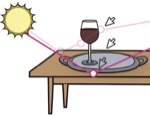
We introduce an alternative to Monte-Carlo techniques for solving radiance transport problems for participating media. We use a reformulation of the volume rendering equation from its standard integro-differential form to a purely differential form. We then leverage the large body of work in numerical methods for solving differential equations by framing and analyzing the problem as a differential equation. To our knowledge, this is the first application of such techniques in the area of photo-realistic rendering of volumes based on ray optics.

Citation

Derek Nowrouzezahrai and Chris Gonterman. Solving radiance transport as a differential equation. Technical Report CSRG-588, Department of Computer Science, University of Toronto, Toronto, Canada, December 2008. [BiBTeX]

Fast Soft Self-Shadowing on Dynamic Height Fields

John Snyder and Derek Nowrouzezahrai

Abstract

We present a new, real-time method for rendering soft shadows from large light sources or lighting environments on dynamic height fields. The method first computes a horizon map for a set of azimuthal directions. To reduce sampling, we compute a multi-resolution pyramid on the height field. Coarser pyramid levels are indexed as the distance from caster to receiver increases. For every receiver point and every azimuthal direction, a smooth function of blocking angle in terms of log distance is reconstructed from a height difference sample at each pyramid level. This function's maximum approximates the horizon angle. We then sum visibility at each receiver point over wedges determined by successive pairs of horizon angles. Each wedge represents a linear transition in blocking angle over its azimuthal extent. It is precomputed in the order-4 spherical harmonic (SH) basis, for a canonical azimuthal origin and fixed extent, resulting in a 2D table. The SH triple product of 16D vectors representing lighting, total visibility, and diffuse reflectance then yields the soft-shadowed result. Two types of light sources are considered; both are distant and low-frequency. Environmental lights require visibility sampling around the complete 360 degree azimuth, while key lights sample visibility within a partial swath. Restricting the swath concentrates samples where the light comes from (e.g. 3 azimuthal directions vs. 16-32 for a full swath) and obtains sharper shadows. Our GPU implementation handles height fields up to 1024x1024 in real-time. The computation is simple, local, and parallel, with performance independent of geometric content.

Citation

John Snyder and Derek Nowrouzezahrai. Fast soft self-shadowing on dynamic height fields. Computer Graphics Forum: Eurographics Symposium on Rendering, 27(4):1275–1283, June 2008. [BiBTeX]

Links

Shadowed Relighting of Dynamic Geometry with 1D BRDFs

Derek Nowrouzezahrai, Evangelos Kalogerakis, Patricio Simari, and Eugene Fiume

Abstract

We present a method for synthesizing the dynamic self-occlusion of an articulating character in real-time (> 170Hz) while incorporating reflection effects from 1D BRDFs under dynamic lighting and view conditions. We introduce and derive a general operator form for convolving spherical harmonics (SH) occlusion vectors with arbitrary 1D BRDF kernels. This operator, coupled with a compact linear model for predicting SH occlusion over articulating meshes, segments the BRDF and visibility terms of the direct illumination integral. We illustrate our results on a thin-membrane translucency model and the normalized Phong BRDF.

Citation

Derek Nowrouzezahrai, Evangelos Kalogerakis, Patricio Simari, and Eugene Fiume. Shadowed relighting of dynamic geometry with 1d brdfs. Proceedings of Eurographics Short Papers, January 2008. [BiBTeX]

Links

Video browsing by direct manipulation

Pierre Dragicevic, Gonzalo Ramos, Jacobo Bibliowicz, Derek Nowrouzezahrai, Ravin Balakrishnan, and Karan Singh

Abstract

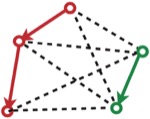
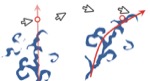
We present a method for browsing videos by directly dragging their content. This method brings the benefits of direct manipulation to an activity typically mediated by widgets. We support this new type of interactivity by: 1) automatically extracting motion data from videos; and 2) a new technique called relative flow dragging that lets users control video playback by moving objects of interest along their visual trajectory. We show that this method can outperform the traditional seeker bar in video browsing tasks that focus on visual content rather than time.

Citation

Pierre Dragicevic, Gonzalo Ramos, Jacobo Bibliowicz, Derek Nowrouzezahrai, Ravin Balakrishnan, and Karan Singh. Video browsing by direct manipulation. In CHI '08: Proceeding of the twenty-sixth annual SIGCHI conference on Human factors in computing systems, pages 237–246, New York, NY, USA, 2008. ACM. [BiBTeX]

Links

Academic Service (Reviewing and Affiliations)
  • Reviewer for ACM Transactions on Graphics Journal
  • Reviewer for ACM SIGGRAPH Sketches
  • Reviewer for EUROGRAPHICS Conference
  • Reviewer for Graphics Interface Conference
  • Reviewer for Computers and Graphics (C&G) Journal
  • Reviewer for High Performance Computing
  • Reviewer for C&G Spec. Ed. on Natural Phenomena
  • Reviewer for Journal of Supercomputing
  • Active member of the ACM and EUROGRAPHICS
  • Member of the Dynamic Graphics Project
Companies I've Worked For
Research in Motion Amazon.com Electronic Arts Canada Microsoft Microsoft Research Redmond Disney Research Zurich